GLIAC Men's BasketballJan 5, 2016 by Joe Battaglia
How Ben Simmons Could Have An Easier Time In The NBA
How Ben Simmons Could Have An Easier Time In The NBA
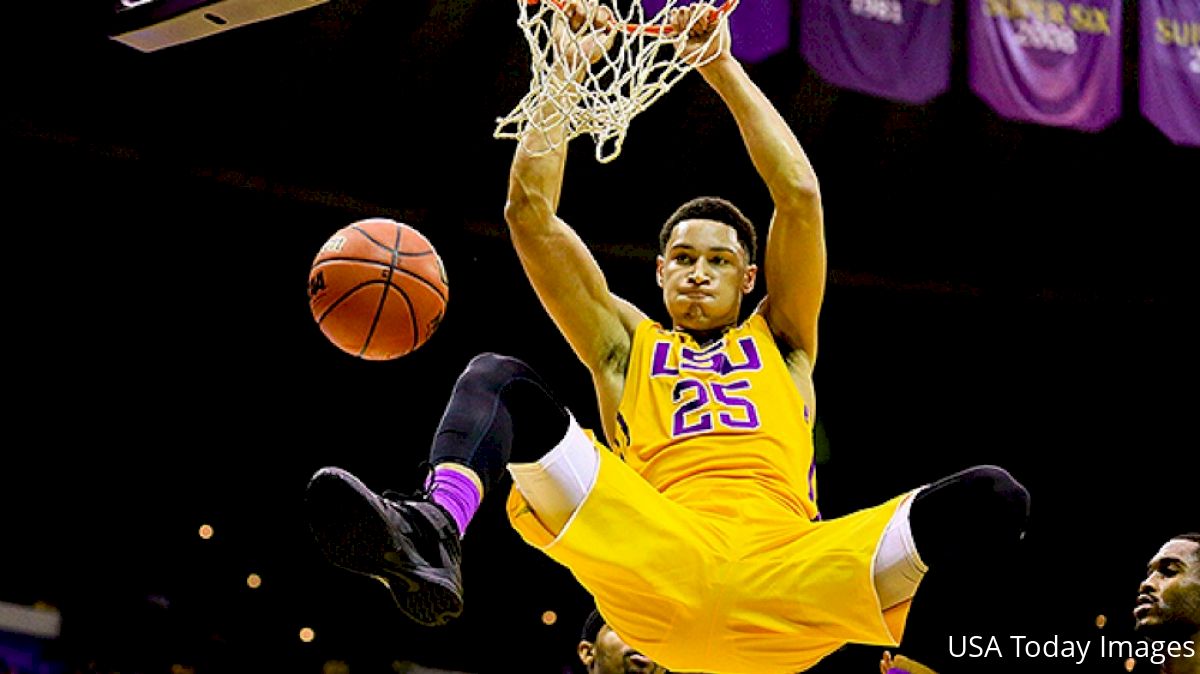
FloHoops looks at LSU freshman Ben Simmons and examines how his effectiveness will project once he is effectively defended by NBA pros.
By Miles Wray
Even though he’s barely a dozen games into his collegiate career, I’m very excited for the impending NBA arrival of LSU freshman forward Ben Simmons, who is projected by DraftExpress to be the #1 pick of the 2016 Draft. I’m excited not because Simmons resembles LeBron James, as has been breathlessly hyped -- I actually don’t see a lot of parallels there, to be honest, as Simmons’ game relies so much on finesse, where James operates using raw power. I’m excited because I’m not sure we’ve ever seen a player quite like Simmons.
For starters, there is Simmons’ monstrous average stat line: 19.1 points per game, 13.1 rebounds, 5.8 assists, 2.3 steals, 1.4 blocks. Simmons leads his team in both the per-game average and the raw total in each category. While that’s impressive on its own, what I find really cool about Simmons’ season is how virtually no players over the last 20 years* have posted these same statistics at the same time. You can chop up Simmons’ average box score in any way you want and return impressive results.
*Sports-Reference’s Play Index searches go back to the 1995-96 season.
How many freshmen in the last two decades have averaged at least 15 points and 10 rebounds? Twelve: one is Simmons, two are still in school, and eight of the other nine made the NBA, including stars like Kevin Love and Kevin Durant. Now, how many players -- freshmen up through seniors -- averaged 15, 10, and five assists? Just Simmons. What about only the 10 rebounds and five assists? Just Simmons again.
Part of what makes Simmons unique, honestly, is his ability to do all of these things while being very uncomfortable and ineffective when shooting from outside the key. This certainly sounds something like a career-ender for any player who enters the NBA during this current golden age of the 3-pointer. When Simmons dropped 43 points on North Florida in November, his incredibly clustered shot chart seemed to simultaneously inspire awe and worry:
[tweet url="https://twitter.com/espn/status/672250996605722624" hide_media="0" hide_thread="1"]
Awe because of how many baskets Simmons was able to collect, and worry because NBA defenses won’t allow continual shots at the rim, as North Florida did. Doesn’t so much of Simmons’ effectiveness vanish once he is effectively defended by the pros?
Maybe. Even after considering, though, that recent high-lottery picks like Aaron Gordon, Elfrid Payton, and Nerlens Noel have played great NBA basketball despite limited ranges, I feel that Simmons has an incredible chance to succeed because of his preternatural passing ability and unselfish court vision. I almost suspect that Simmons’ scoring rate will go down once he joins the NBA, while his assist average will rise. Simmons has an uncanny feel for moving the ball to the player with the best chance of scoring. Considering that LSU, as a team, is ranked somewhere around the 200’s in the nation in terms of 3-point accuracy, that player with the best chance is often Simmons.
In fact, I wonder if the team surrounding Simmons at LSU is holding his game back -- at least, statistically speaking -- in meaningful ways. Given Simmons’ continual instinct to make the correct pass before he takes his own shot, his game may very well improve dramatically as the quality of the teammates around him improve dramatically as well. Consider this: according to DraftExpress, Simmons’ high school game averages were 25.2 minutes per game and 2.2 assists. Having made the leap from high school to collegiate teammates, Simmons is already up to 5.8 assists per game in 33.8 minutes -- easily doubling his number of assists per minute.
That rate could be significantly higher, though. Take this following play, a very smooth drive in semi-transition against North Florida. Simmons (wearing #25) looks off a 3-point shooter, deciding that the percentages are better to pass to his teammate in the low post:
The pass is on-target and leads Simmons’ teammate to the hoop -- but the shot is not converted. Simmons receives no statistical credit for an incredibly cerebral and calculated play.
Simmons is also very effective at passing out of a standstill, running an offense from the low post. In this possession in a later game against American University, look how Simmons methodically surveys the entire court before hitting the open man immediately when he flashes open:
Another brilliant shot created -- and nothing for the statistician to mark down.
A few minutes later in the same game, Simmons receives the ball in the same spot, only this time there is no obvious play called. After a few seconds of his four teammates more or less staring at him and waiting for something to happen, Simmons’ internal clock goes off and he attempts a haphazard jump hook. No, it’s not a great shot -- but it’s the best shot available to his team on this possession:
Now the lack of team cohesion registers in the box score as a missed shot on Simmons’ part.
Here’s one more example that, once again, doesn’t register as anything for Simmons. On this play, the 2-3 zone from North Florida inexplicably slides halfway up the key, leaving Simmons suddenly alone under the hoop. I suspect an NBA-caliber guard would have lasered a pass inside for an easy two points. Instead, Simmons’ teammates do not see him, and the opening closes:
The NBA comparison that I keep thinking of is actually Shaun Livingston, currently the back-up point guard for the Golden State Warriors. If, in an alternate universe, Livingston does not endure the terrible knee injury in his third NBA season (2006-07), we may very well have seen the full potential that merited his fourth overall selection -- out of high school -- in the 2004 Draft. In our own dimension, Livingston does not play with the explosive prowess of a lottery pick but instead the eternal calm of a savvy veteran.
Although Livingston plays point guard, physically he stacks up somewhat similarly to Simmons: Livingston is three inches shorter (6’7” to 6’10”) and rarely dares to shoot from outside, connecting on under 20% of 3-pointers on just a handful of attempts a season. Also like Simmons, Livingston distributes the ball unselfishly both on the run and from the post.
And, of course, Livingston is playing on what is currently the best basketball team in the world, the Golden State Warriors. Look at how, on Christmas Day, his teammates -- Livingston’s fellow reserves, at that -- quickly get Livingston (wearing #34) the ball in the post, to exploit the size mismatch. From here, Livingston picks apart the opposing defense, catching the help defender (Iman Shumpert) drifting too far away from Andre Iguodala:
As Simmons works to patch the current holes in his own game, let’s also remember that he is the rare post player who can take full advantage of a fully spaced-out floor, and he has yet to play with that luxury.
All statistics via Sports-Reference and Basketball-Reference and accurate as of games played on December 27.
Even though he’s barely a dozen games into his collegiate career, I’m very excited for the impending NBA arrival of LSU freshman forward Ben Simmons, who is projected by DraftExpress to be the #1 pick of the 2016 Draft. I’m excited not because Simmons resembles LeBron James, as has been breathlessly hyped -- I actually don’t see a lot of parallels there, to be honest, as Simmons’ game relies so much on finesse, where James operates using raw power. I’m excited because I’m not sure we’ve ever seen a player quite like Simmons.
For starters, there is Simmons’ monstrous average stat line: 19.1 points per game, 13.1 rebounds, 5.8 assists, 2.3 steals, 1.4 blocks. Simmons leads his team in both the per-game average and the raw total in each category. While that’s impressive on its own, what I find really cool about Simmons’ season is how virtually no players over the last 20 years* have posted these same statistics at the same time. You can chop up Simmons’ average box score in any way you want and return impressive results.
*Sports-Reference’s Play Index searches go back to the 1995-96 season.
How many freshmen in the last two decades have averaged at least 15 points and 10 rebounds? Twelve: one is Simmons, two are still in school, and eight of the other nine made the NBA, including stars like Kevin Love and Kevin Durant. Now, how many players -- freshmen up through seniors -- averaged 15, 10, and five assists? Just Simmons. What about only the 10 rebounds and five assists? Just Simmons again.
Part of what makes Simmons unique, honestly, is his ability to do all of these things while being very uncomfortable and ineffective when shooting from outside the key. This certainly sounds something like a career-ender for any player who enters the NBA during this current golden age of the 3-pointer. When Simmons dropped 43 points on North Florida in November, his incredibly clustered shot chart seemed to simultaneously inspire awe and worry:
[tweet url="https://twitter.com/espn/status/672250996605722624" hide_media="0" hide_thread="1"]
Awe because of how many baskets Simmons was able to collect, and worry because NBA defenses won’t allow continual shots at the rim, as North Florida did. Doesn’t so much of Simmons’ effectiveness vanish once he is effectively defended by the pros?
Maybe. Even after considering, though, that recent high-lottery picks like Aaron Gordon, Elfrid Payton, and Nerlens Noel have played great NBA basketball despite limited ranges, I feel that Simmons has an incredible chance to succeed because of his preternatural passing ability and unselfish court vision. I almost suspect that Simmons’ scoring rate will go down once he joins the NBA, while his assist average will rise. Simmons has an uncanny feel for moving the ball to the player with the best chance of scoring. Considering that LSU, as a team, is ranked somewhere around the 200’s in the nation in terms of 3-point accuracy, that player with the best chance is often Simmons.
In fact, I wonder if the team surrounding Simmons at LSU is holding his game back -- at least, statistically speaking -- in meaningful ways. Given Simmons’ continual instinct to make the correct pass before he takes his own shot, his game may very well improve dramatically as the quality of the teammates around him improve dramatically as well. Consider this: according to DraftExpress, Simmons’ high school game averages were 25.2 minutes per game and 2.2 assists. Having made the leap from high school to collegiate teammates, Simmons is already up to 5.8 assists per game in 33.8 minutes -- easily doubling his number of assists per minute.
That rate could be significantly higher, though. Take this following play, a very smooth drive in semi-transition against North Florida. Simmons (wearing #25) looks off a 3-point shooter, deciding that the percentages are better to pass to his teammate in the low post:
The pass is on-target and leads Simmons’ teammate to the hoop -- but the shot is not converted. Simmons receives no statistical credit for an incredibly cerebral and calculated play.
Simmons is also very effective at passing out of a standstill, running an offense from the low post. In this possession in a later game against American University, look how Simmons methodically surveys the entire court before hitting the open man immediately when he flashes open:
Another brilliant shot created -- and nothing for the statistician to mark down.
A few minutes later in the same game, Simmons receives the ball in the same spot, only this time there is no obvious play called. After a few seconds of his four teammates more or less staring at him and waiting for something to happen, Simmons’ internal clock goes off and he attempts a haphazard jump hook. No, it’s not a great shot -- but it’s the best shot available to his team on this possession:
Now the lack of team cohesion registers in the box score as a missed shot on Simmons’ part.
Here’s one more example that, once again, doesn’t register as anything for Simmons. On this play, the 2-3 zone from North Florida inexplicably slides halfway up the key, leaving Simmons suddenly alone under the hoop. I suspect an NBA-caliber guard would have lasered a pass inside for an easy two points. Instead, Simmons’ teammates do not see him, and the opening closes:
The NBA comparison that I keep thinking of is actually Shaun Livingston, currently the back-up point guard for the Golden State Warriors. If, in an alternate universe, Livingston does not endure the terrible knee injury in his third NBA season (2006-07), we may very well have seen the full potential that merited his fourth overall selection -- out of high school -- in the 2004 Draft. In our own dimension, Livingston does not play with the explosive prowess of a lottery pick but instead the eternal calm of a savvy veteran.
Although Livingston plays point guard, physically he stacks up somewhat similarly to Simmons: Livingston is three inches shorter (6’7” to 6’10”) and rarely dares to shoot from outside, connecting on under 20% of 3-pointers on just a handful of attempts a season. Also like Simmons, Livingston distributes the ball unselfishly both on the run and from the post.
And, of course, Livingston is playing on what is currently the best basketball team in the world, the Golden State Warriors. Look at how, on Christmas Day, his teammates -- Livingston’s fellow reserves, at that -- quickly get Livingston (wearing #34) the ball in the post, to exploit the size mismatch. From here, Livingston picks apart the opposing defense, catching the help defender (Iman Shumpert) drifting too far away from Andre Iguodala:
As Simmons works to patch the current holes in his own game, let’s also remember that he is the rare post player who can take full advantage of a fully spaced-out floor, and he has yet to play with that luxury.
All statistics via Sports-Reference and Basketball-Reference and accurate as of games played on December 27.