GLIAC Men's BasketballJan 29, 2016 by Brett Pickert
Hit Me Bebe One More Time: The Development of Lucas “Bebe” Nogueira
Hit Me Bebe One More Time: The Development of Lucas “Bebe” Nogueira
As young players develop into their primes, the conventional wisdom is that there’s no substitute for giving those players minutes in real game.
By Miles Wray
As young players develop into their primes, the conventional wisdom is that there’s no substitute for giving those players minutes in real games in front of paying audiences. Practice as much as you’d like, but there’s no competition equal to a real-life opponent going against you. If a rebuilding NBA team is smart, they will never simply watch the clock and tank for the lottery -- they will invest their valuable game minutes in young players who can lead the team in future seasons.
But what if you have very young, very raw prospects on your team, and you’re also an annual NBA Playoff entrant? If that’s the case, your team needs results, and can’t afford to invest too many game minutes in the process of player development. This is where the Toronto Raptors currently find themselves. Raptors General Manager Masai Ujiri is most famous for taking a huge gamble on Brazilian swingman Bruno Caboclo, a prospect of near-total obscurity up until the moment he was drafted by the team at #20 in 2014. Days after Ujiri made that pick, though, he traded for another Brazilian prospect who had also only played internationally, and also in limited minutes: 2013 first-round selection Lucas Nogueira.
In the two seasons that Nogueira has been with the Raptors, he has played extremely sporadically. Over the 2014-15 season, Nogueira was on the court for only 103 total minutes -- 23 in the NBA and 80 in the NBDL with the Fort Wayne Mad Ants. So far in 2015-16, that number is up to 294: 115 minutes in Toronto (7.7 MPG over 15 games), and 179 in Mississauga with Raptors 905, an NBDL expansion team (25.6 MPG over seven games). This is hardly any playing time at all. The Raptors clearly believe that there are benefits to keeping Nogueira with the big club most of the time, even while rarely playing, as they send him to the D-League only for brief days at a time.
Unlike most players who see the NBA court that infrequently, though, Nogueira has been incredibly effective when on the floor. Nogueira has made an incredible 75.0% of his field goal attempts this year -- which would be the second-best accuracy, ever, in any NBA season of at least 100 minutes. His 19.3 PER is also fourth-best on Toronto behind team-leading stars DeMar DeRozan, Jonas Valanciunas, and All-Star starter Kyle Lowry. What’s more, Nogueira’s two longest appearances -- which consist of more than a third of his season -- came in competitive games against elite teams, the Atlanta Hawks (16 minutes) and Golden State Warriors (25 minutes).
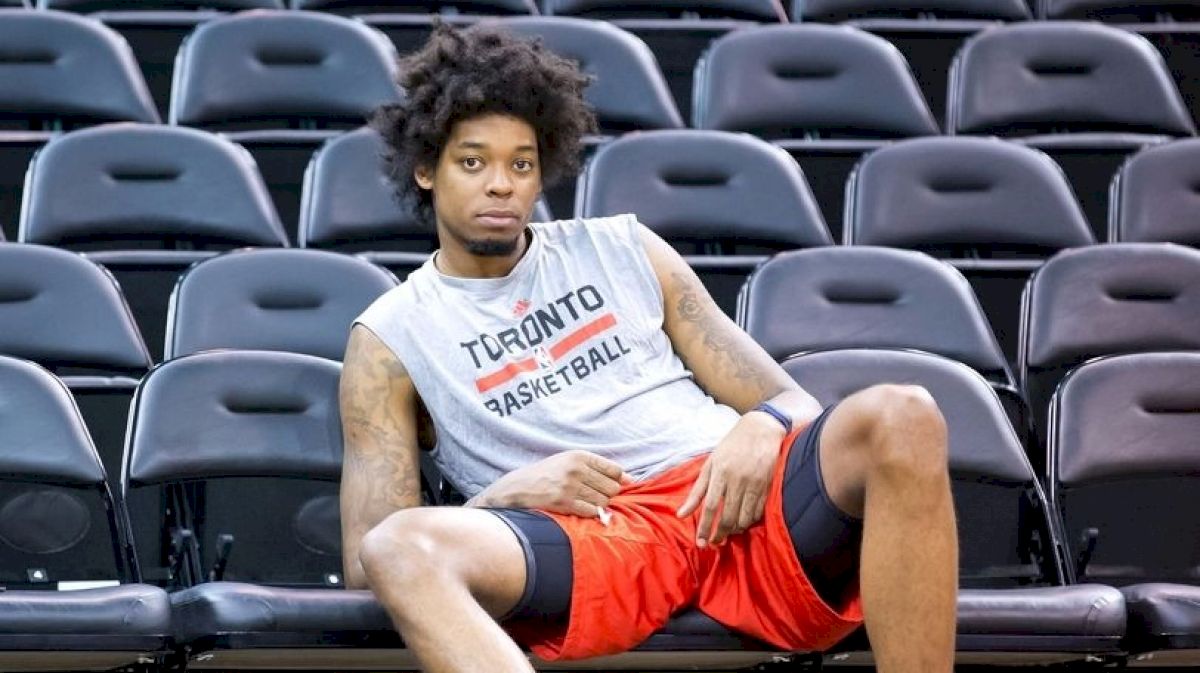
Nogueira is an incredibly wiry seven-foot center with a massive afro and infectious positive attitude. Both traits are immediately obvious in this interview, conducted at the 2014 Summer League just weeks after the Raptors traded for him:
What’s also obvious from the interview is Nogueira’s instinctual knack for smart, selfless play. As he described his on-court role: “Make good screens, roll all the time.”
Nearly eighteen months after that interview, playing against the (then-undefeated) Warriors, Nogueira’s habit of first setting a massive screen and then emphatically crashing to the rim would pay dividends against the defending champions. In a tight fourth quarter, Nogueira (wearing #92) worked an effective two-man game with Lowry to free the point guard for an open 3-pointer:
The Raptors noticed that Nogueira’s man (Marreese Speights, #5) did not want to venture out of the key. Meantime, Nogueira had the agility and energy to set the pick for Lowry well outside of the 3-point arc, which helped create significant open space for the shot.
So, on the very next possession, Lowry and Nogueira worked to exploit the lack of pressure from their opponent, Speights. Nogueira again sets a very high pick, and this time, Lowry hits his center with the pass as Nogueira flows “downhill” toward the rim:
While Nogueira has limited shooting range, like most centers, he is far from a plodding, traditional center due to his exceptional passing ability. Earlier in the same game, look at how Nogueira saves a Raptors possession with a brilliant pass in traffic as the shot clock expires:
Nogueira’s assist numbers in the D-League have been insane: he completes an assist on 24.4% of his team’s made field goals, which rivals the percentages from his teammates who are guards. Creatively, Nogueira’s D-League coaches have used him as a floor spacer -- even without the threat to shoot. Look at the quick decision-making process from Nogueira at the top of the key (he wears #11 in the D-League):
Importantly, Nogueira’s ability to create with his passing draws his man (#30 Adreian Payne, a first-round draft pick in 2014) into space, away from his role as a rim protector.
On the 905’s next possession, Nogueira’s presence spaces the floor wide enough so that his teammate can drive all the way to the rim. Without touching the ball, Nogueira eliminates the opponent’s biggest defender, Payne, from the play, opening up the key for the 905:
Watching Nogueira, I really enjoy the creativity and “bounce” he brings to the game -- but I also understand why he hasn’t fit into a permanent NBA role more than two years after he was first drafted. There aren’t very many players who are both extremely creative offensively and who also average around eight points a game against NBDL competition. It’s hard to think of projections or comparisons for Nogueira as a regular in an NBA rotation.
Nogueira’s more serious problems are probably on the defensive end, where he is effectively stuck between positions. While he excels at swooping in to block shots on help defense, Nogueira is currently very thin against most traditional centers, and also currently lacks the agility to keep up with “stretchier” big men.
Still, Nogueira’s style and creativity are, if nothing else, incredibly fun to watch. If I had to predict, Toronto’s long-game development plan will eventually pay dividends -- one generation of players seamlessly blending into the next.
As young players develop into their primes, the conventional wisdom is that there’s no substitute for giving those players minutes in real games in front of paying audiences. Practice as much as you’d like, but there’s no competition equal to a real-life opponent going against you. If a rebuilding NBA team is smart, they will never simply watch the clock and tank for the lottery -- they will invest their valuable game minutes in young players who can lead the team in future seasons.
But what if you have very young, very raw prospects on your team, and you’re also an annual NBA Playoff entrant? If that’s the case, your team needs results, and can’t afford to invest too many game minutes in the process of player development. This is where the Toronto Raptors currently find themselves. Raptors General Manager Masai Ujiri is most famous for taking a huge gamble on Brazilian swingman Bruno Caboclo, a prospect of near-total obscurity up until the moment he was drafted by the team at #20 in 2014. Days after Ujiri made that pick, though, he traded for another Brazilian prospect who had also only played internationally, and also in limited minutes: 2013 first-round selection Lucas Nogueira.
In the two seasons that Nogueira has been with the Raptors, he has played extremely sporadically. Over the 2014-15 season, Nogueira was on the court for only 103 total minutes -- 23 in the NBA and 80 in the NBDL with the Fort Wayne Mad Ants. So far in 2015-16, that number is up to 294: 115 minutes in Toronto (7.7 MPG over 15 games), and 179 in Mississauga with Raptors 905, an NBDL expansion team (25.6 MPG over seven games). This is hardly any playing time at all. The Raptors clearly believe that there are benefits to keeping Nogueira with the big club most of the time, even while rarely playing, as they send him to the D-League only for brief days at a time.
Unlike most players who see the NBA court that infrequently, though, Nogueira has been incredibly effective when on the floor. Nogueira has made an incredible 75.0% of his field goal attempts this year -- which would be the second-best accuracy, ever, in any NBA season of at least 100 minutes. His 19.3 PER is also fourth-best on Toronto behind team-leading stars DeMar DeRozan, Jonas Valanciunas, and All-Star starter Kyle Lowry. What’s more, Nogueira’s two longest appearances -- which consist of more than a third of his season -- came in competitive games against elite teams, the Atlanta Hawks (16 minutes) and Golden State Warriors (25 minutes).
Nogueira is an incredibly wiry seven-foot center with a massive afro and infectious positive attitude. Both traits are immediately obvious in this interview, conducted at the 2014 Summer League just weeks after the Raptors traded for him:
What’s also obvious from the interview is Nogueira’s instinctual knack for smart, selfless play. As he described his on-court role: “Make good screens, roll all the time.”
Nearly eighteen months after that interview, playing against the (then-undefeated) Warriors, Nogueira’s habit of first setting a massive screen and then emphatically crashing to the rim would pay dividends against the defending champions. In a tight fourth quarter, Nogueira (wearing #92) worked an effective two-man game with Lowry to free the point guard for an open 3-pointer:
The Raptors noticed that Nogueira’s man (Marreese Speights, #5) did not want to venture out of the key. Meantime, Nogueira had the agility and energy to set the pick for Lowry well outside of the 3-point arc, which helped create significant open space for the shot.
So, on the very next possession, Lowry and Nogueira worked to exploit the lack of pressure from their opponent, Speights. Nogueira again sets a very high pick, and this time, Lowry hits his center with the pass as Nogueira flows “downhill” toward the rim:
While Nogueira has limited shooting range, like most centers, he is far from a plodding, traditional center due to his exceptional passing ability. Earlier in the same game, look at how Nogueira saves a Raptors possession with a brilliant pass in traffic as the shot clock expires:
Nogueira’s assist numbers in the D-League have been insane: he completes an assist on 24.4% of his team’s made field goals, which rivals the percentages from his teammates who are guards. Creatively, Nogueira’s D-League coaches have used him as a floor spacer -- even without the threat to shoot. Look at the quick decision-making process from Nogueira at the top of the key (he wears #11 in the D-League):
Importantly, Nogueira’s ability to create with his passing draws his man (#30 Adreian Payne, a first-round draft pick in 2014) into space, away from his role as a rim protector.
On the 905’s next possession, Nogueira’s presence spaces the floor wide enough so that his teammate can drive all the way to the rim. Without touching the ball, Nogueira eliminates the opponent’s biggest defender, Payne, from the play, opening up the key for the 905:
Watching Nogueira, I really enjoy the creativity and “bounce” he brings to the game -- but I also understand why he hasn’t fit into a permanent NBA role more than two years after he was first drafted. There aren’t very many players who are both extremely creative offensively and who also average around eight points a game against NBDL competition. It’s hard to think of projections or comparisons for Nogueira as a regular in an NBA rotation.
Nogueira’s more serious problems are probably on the defensive end, where he is effectively stuck between positions. While he excels at swooping in to block shots on help defense, Nogueira is currently very thin against most traditional centers, and also currently lacks the agility to keep up with “stretchier” big men.
Still, Nogueira’s style and creativity are, if nothing else, incredibly fun to watch. If I had to predict, Toronto’s long-game development plan will eventually pay dividends -- one generation of players seamlessly blending into the next.