By Miles Wray
The biggest story in the NBA this season, and with good reason, has been and will continue to be how Stephen Curry and the Golden State Warriors have revolutionized the game with their remarkable three-point shooting. The fun facts about the Warriors’ game-altering marksmanship simply do not stop. With 41.9% accuracy on three-pointers this season, Golden State is the second-most-accurate team of all time -- trailing only the 1997-98 Charlotte Hornets (42.8%), who spaced out the floor with a 32-year-old Dell Curry. If the Warriors’ season stopped right now, they would still be among the top 25 teams in total three-point makes across 82-game seasons.
Believe it or not, the 2015-16 Warriors actually are not blazing any new territory in terms of the rate they take their three-point shots. So far, 35.1% of the Warriors’ field goal attempts have been three-pointers. If that sounds like a lot, well, it is: that’s the fourth-highest rate of all-time. But also, it isn’t even the highest rate of this NBA season -- this year’s Houston Rockets are attempting threes with 37.8% of their shots, and last year’s Rockets set the all-time record by a massive margin, at 39.2%. Houston is attempting multiple three-pointers more than Golden State each game. And even if the Rockets weren’t so far ahead: the Warriors are running one of the fifteen best per-possession offenses in league history, and doing so while shooting two-pointers about 65% of the time. Does it really surprise you to learn that Golden State is among the top 25 teams in two-point field goal accuracy in league history as well?
What’s fascinating about Golden State’s offense is that they virtually neglect certain play types -- like the post-up -- and are among the least efficient teams at those types of plays in 2015-16. Coach Steve Kerr has his team producing a large portion of their possessions in the more fluid areas of the game -- like in transition, and finishes off of cuts -- and the Warriors are elite in those areas. The chart below shows what percentage of their offensive possessions the Warriors use to run a certain type of play, the points they get per possession off that play type, and also their league ranking in both categories, as compiled by NBA.com:
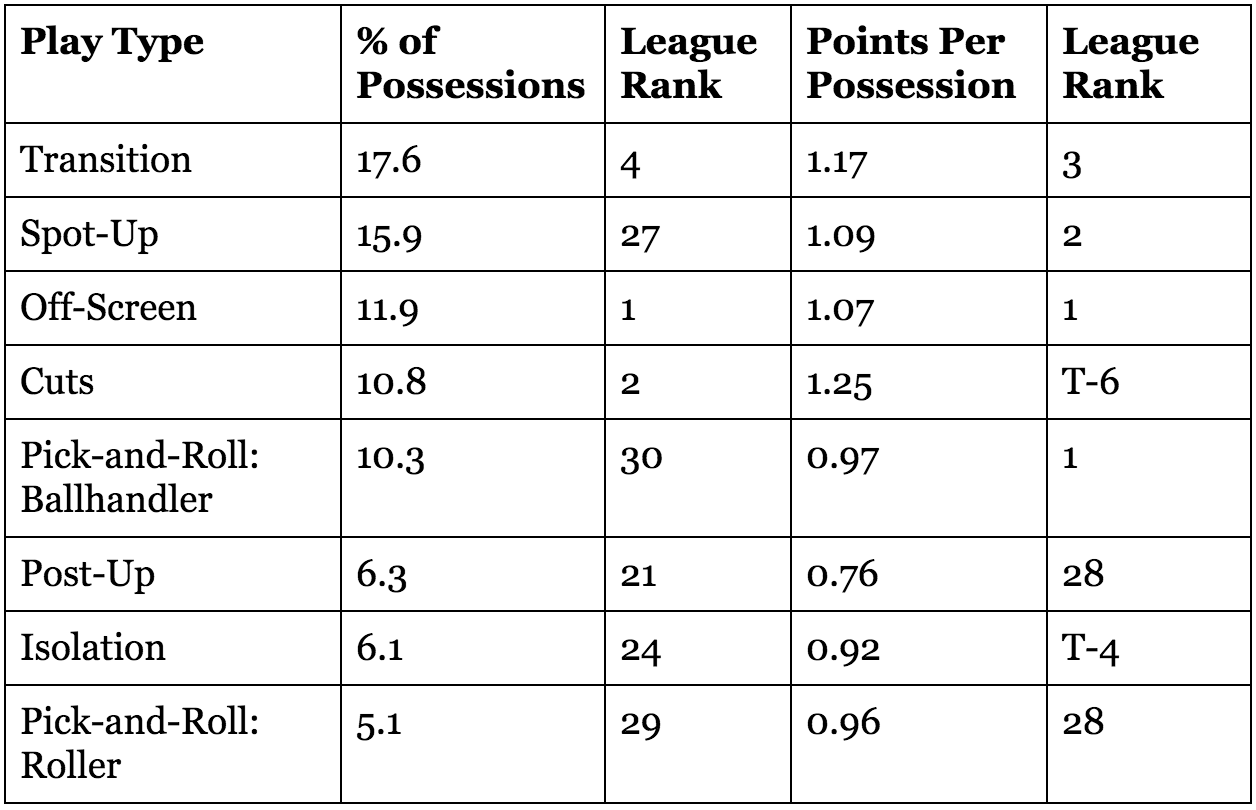
Note: This chart does not display all 100% of Warriors possessions, excluding the smaller categories of Hand-Offs, Putbacks, and Miscellaneous.
There is an elegance and a common sense to the Warriors offense when you look at it this way: there are certain play categories that are just naturally more efficient than others. For example, this year’s very weakest teams in transition (Los Angeles Lakers and Chicago Bulls) still produce more points per possession on those plays than the very strongest team in isolation (Los Angeles Clippers). The Warriors have clearly made a conscious attempt to generate more looks out of those fluid, team-oriented plays than the one-man, stand-still shows of post-ups and isolations.
Just to show how different these designs can get, here’s how one of the league’s least motivated offenses, the Lakers, looks in certain categories on the same chart:
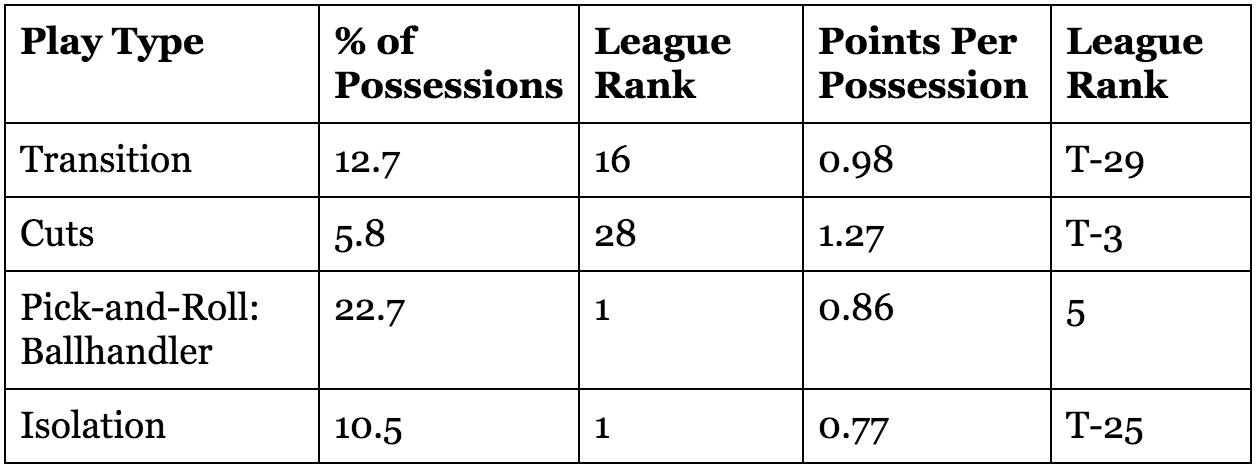
The Lakers are actually really good when the pick-and-roll ball handler shoots! Well, good by comparison -- that category of plays, by its nature, doesn’t yield as many points per possession as something more fluid like transition or cutting. Los Angeles is spending massive amounts of their precious possessions working in categories of plays that just don’t work as well.
Here’s a closer look at the four categories of plays that the Warriors use most often -- which are, sensibly, the four categories that they also get the most per-play production from:
Transition / Team Breakdown
It was not lip service when the Warriors thanked Mike D’Antoni -- who coached the Phoenix Suns while Steve Kerr was GM -- upon winning the championship last June. Golden State has genuinely adopted D’Antoni’s philosophy of generating great offense by fearlessly and relentlessly pushing the ball. Curry, Andre Iguodala, Harrison Barnes, and Leandro Barbosa all take over 20% of their shots in transition.
Spot-Up / Team Breakdown
While Curry is deadly at these types of possessions, at 1.44 points per possession, this is more the domain of wings Barnes, Iguodala, and Klay Thompson. These plays tend to happen when the Warriors break a defense down and then begin whirring the ball around the court in pursuit of the open man.
Off Screen / Team Breakdown
This portion of the Warriors’ offense is almost entirely designed plays to get Curry and Thompson open shots. Uh, not a bad idea.
Cuts / Team Breakdown
Surprisingly, cutting takes up a gigantic portion of offense for rotating centers Andrew Bogut and Festus Ezeli. Usually, Bogut is just thought of for his stifling defense, but the truth is that he also has great instincts to make a beautiful offense flow. Bogut’s absurdly low 5.6 points in 21.2 minutes per game is a result of his unselfishness -- he has a higher assist percentage than guards Thompson or Barbosa, and only takes efficient shots, with a 62.0% field goal percentage.
All statistics accurate as of games played on March 2.
The biggest story in the NBA this season, and with good reason, has been and will continue to be how Stephen Curry and the Golden State Warriors have revolutionized the game with their remarkable three-point shooting. The fun facts about the Warriors’ game-altering marksmanship simply do not stop. With 41.9% accuracy on three-pointers this season, Golden State is the second-most-accurate team of all time -- trailing only the 1997-98 Charlotte Hornets (42.8%), who spaced out the floor with a 32-year-old Dell Curry. If the Warriors’ season stopped right now, they would still be among the top 25 teams in total three-point makes across 82-game seasons.
Believe it or not, the 2015-16 Warriors actually are not blazing any new territory in terms of the rate they take their three-point shots. So far, 35.1% of the Warriors’ field goal attempts have been three-pointers. If that sounds like a lot, well, it is: that’s the fourth-highest rate of all-time. But also, it isn’t even the highest rate of this NBA season -- this year’s Houston Rockets are attempting threes with 37.8% of their shots, and last year’s Rockets set the all-time record by a massive margin, at 39.2%. Houston is attempting multiple three-pointers more than Golden State each game. And even if the Rockets weren’t so far ahead: the Warriors are running one of the fifteen best per-possession offenses in league history, and doing so while shooting two-pointers about 65% of the time. Does it really surprise you to learn that Golden State is among the top 25 teams in two-point field goal accuracy in league history as well?
What’s fascinating about Golden State’s offense is that they virtually neglect certain play types -- like the post-up -- and are among the least efficient teams at those types of plays in 2015-16. Coach Steve Kerr has his team producing a large portion of their possessions in the more fluid areas of the game -- like in transition, and finishes off of cuts -- and the Warriors are elite in those areas. The chart below shows what percentage of their offensive possessions the Warriors use to run a certain type of play, the points they get per possession off that play type, and also their league ranking in both categories, as compiled by NBA.com:
Note: This chart does not display all 100% of Warriors possessions, excluding the smaller categories of Hand-Offs, Putbacks, and Miscellaneous.
There is an elegance and a common sense to the Warriors offense when you look at it this way: there are certain play categories that are just naturally more efficient than others. For example, this year’s very weakest teams in transition (Los Angeles Lakers and Chicago Bulls) still produce more points per possession on those plays than the very strongest team in isolation (Los Angeles Clippers). The Warriors have clearly made a conscious attempt to generate more looks out of those fluid, team-oriented plays than the one-man, stand-still shows of post-ups and isolations.
Just to show how different these designs can get, here’s how one of the league’s least motivated offenses, the Lakers, looks in certain categories on the same chart:
The Lakers are actually really good when the pick-and-roll ball handler shoots! Well, good by comparison -- that category of plays, by its nature, doesn’t yield as many points per possession as something more fluid like transition or cutting. Los Angeles is spending massive amounts of their precious possessions working in categories of plays that just don’t work as well.
Here’s a closer look at the four categories of plays that the Warriors use most often -- which are, sensibly, the four categories that they also get the most per-play production from:
Transition / Team Breakdown
It was not lip service when the Warriors thanked Mike D’Antoni -- who coached the Phoenix Suns while Steve Kerr was GM -- upon winning the championship last June. Golden State has genuinely adopted D’Antoni’s philosophy of generating great offense by fearlessly and relentlessly pushing the ball. Curry, Andre Iguodala, Harrison Barnes, and Leandro Barbosa all take over 20% of their shots in transition.
Spot-Up / Team Breakdown
While Curry is deadly at these types of possessions, at 1.44 points per possession, this is more the domain of wings Barnes, Iguodala, and Klay Thompson. These plays tend to happen when the Warriors break a defense down and then begin whirring the ball around the court in pursuit of the open man.
Off Screen / Team Breakdown
This portion of the Warriors’ offense is almost entirely designed plays to get Curry and Thompson open shots. Uh, not a bad idea.
Cuts / Team Breakdown
Surprisingly, cutting takes up a gigantic portion of offense for rotating centers Andrew Bogut and Festus Ezeli. Usually, Bogut is just thought of for his stifling defense, but the truth is that he also has great instincts to make a beautiful offense flow. Bogut’s absurdly low 5.6 points in 21.2 minutes per game is a result of his unselfishness -- he has a higher assist percentage than guards Thompson or Barbosa, and only takes efficient shots, with a 62.0% field goal percentage.
All statistics accurate as of games played on March 2.