GLIAC Men's BasketballMar 16, 2016 by Joe Battaglia
Hakeem Olajuwon On How To Save The Post-Up Game
Hakeem Olajuwon On How To Save The Post-Up Game
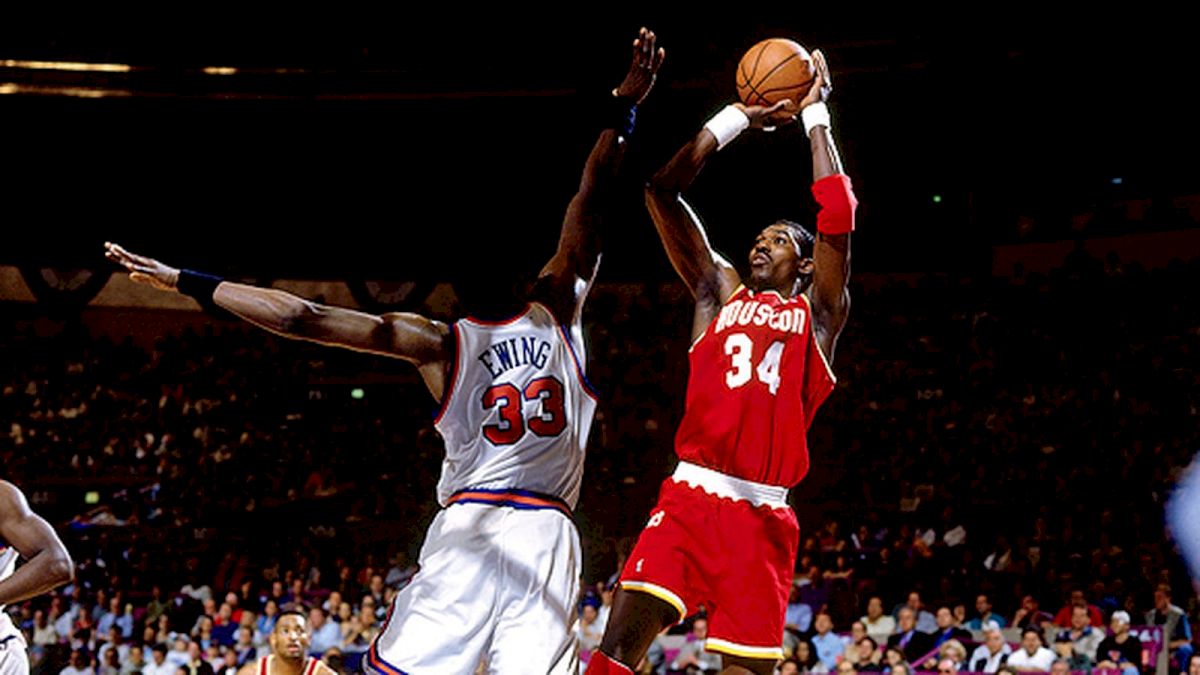
Hall-of-Fame center Hakeem Olajuwon weighs in on how he would be effective in the modern game.
By Mo Mooncey
NBA Basketball is an evolutionary sport. As athletes develop, new rules are introduced; styles of play shift, leaving the modern game a far cry to what was played when James Naismith hung two peach baskets in his gym for the first time. In recent years teams around the league have started employing a strategy more commonly known as “small ball”.
The Miami Heat took advantage of the versatility of Lebron James and first used this strategy by playing him at the power forward position, creating a matchup nightmare for traditional power forwards who were too slow to keep up with James. Furthermore they shifted Chris Bosh from the power forward position to center.
Putting a player like Bosh, who has extensive shooting range, at the pivot spot created problems for defenses that relied on a 7-foot shot blocker clogging up the paint and denying buckets at the rim. With Bosh forcing centers to defend him on the perimeter, the floor opened up for James to blow by his defender and penetrate into the paint, forcing the entire defense to collapse, allowing James to kick the ball out to wide-open 3-point shooters.
Whilst this may be an oversimplification, it is the strategy that allowed Heat to win successive NBA championships in 2012 and 2013.
In this league, if something works, teams will copy it.
The success enjoyed by the Golden State Warriors as of late has highlighted the importance of floor spacing and the effectiveness of 3-point shooting. The Dubs also dropped traditional center Andrew Bogut from their starting line-up during the NBA finals, replacing him with Draymond Green, who could also stretch the floor. Teams are now playing with a lot more pace, and relying on jump shots a hell of a lot more. According to some NBA purists, the post game is becoming extinct.
While it seems that this season every NBA legend is commenting on how the Warriors wouldn’t survive their eras because it was so much tougher back then, Hall-of-Fame center Hakeem Olajuwon weighed in on how he would be effective in the modern game, that apparently no longer has a need for traditional centers.
This sounds simple enough. But unlike the ‘90’s that Olajuwon dominated, when defenses would attempt to stop whoever had the ball on the block, today’s defensive schemes encourage teams to deny the ball from even initially reaching the post. So how would Olajuwon adapt to defeat modern defensive schemes?
The traditional center position in the NBA is dying out as big men are now more focused on layups or spot-up 3-point shots, a trend which the two-time NBA champion with the Houston Rockets doesn’t think should be happening if a player is good enough.
The theory put forward by Olajuwon is essentially this: the post up game can still be highly effective if you are good enough.
Looking around the NBA and comparing players to Hakeem’s era, there is currently a distinct lack of quality players that are effective with their back to the basket. Pace-and-space is a trend that looks set to continue, but it will be interesting to see how the game evolves over the course of the next 20 years.
Follow @TheHoopGenius on Twitter for more NBA news, views, and updates.
NBA Basketball is an evolutionary sport. As athletes develop, new rules are introduced; styles of play shift, leaving the modern game a far cry to what was played when James Naismith hung two peach baskets in his gym for the first time. In recent years teams around the league have started employing a strategy more commonly known as “small ball”.
The Miami Heat took advantage of the versatility of Lebron James and first used this strategy by playing him at the power forward position, creating a matchup nightmare for traditional power forwards who were too slow to keep up with James. Furthermore they shifted Chris Bosh from the power forward position to center.
Putting a player like Bosh, who has extensive shooting range, at the pivot spot created problems for defenses that relied on a 7-foot shot blocker clogging up the paint and denying buckets at the rim. With Bosh forcing centers to defend him on the perimeter, the floor opened up for James to blow by his defender and penetrate into the paint, forcing the entire defense to collapse, allowing James to kick the ball out to wide-open 3-point shooters.
Whilst this may be an oversimplification, it is the strategy that allowed Heat to win successive NBA championships in 2012 and 2013.
In this league, if something works, teams will copy it.
The success enjoyed by the Golden State Warriors as of late has highlighted the importance of floor spacing and the effectiveness of 3-point shooting. The Dubs also dropped traditional center Andrew Bogut from their starting line-up during the NBA finals, replacing him with Draymond Green, who could also stretch the floor. Teams are now playing with a lot more pace, and relying on jump shots a hell of a lot more. According to some NBA purists, the post game is becoming extinct.
While it seems that this season every NBA legend is commenting on how the Warriors wouldn’t survive their eras because it was so much tougher back then, Hall-of-Fame center Hakeem Olajuwon weighed in on how he would be effective in the modern game, that apparently no longer has a need for traditional centers.
You have to understand small ball has always been popular, but anytime you have a dominant big man, it causes so much trouble on that end, meaning lots of double-teams, if a 6-7 guy is guarding me, I’m going to get a layup all day, He’s too small. He doesn’t have the size. So, now what do they do? Guard with two or three guys, double-team. Then you swing it around to shoot threes.
This sounds simple enough. But unlike the ‘90’s that Olajuwon dominated, when defenses would attempt to stop whoever had the ball on the block, today’s defensive schemes encourage teams to deny the ball from even initially reaching the post. So how would Olajuwon adapt to defeat modern defensive schemes?
A whole lot of it is in the pick-and-roll. You want to keep running your offense, so you leave the post quickly and set a pick for your guy. Then you create a mismatch on the other guy. Or, you can go back and set a pick on the other post. You don’t get the ball on the set play. You get it on the move. On the offensive end, the first thing you do is run down the middle and set so you can position for the play. So, the set play is a good way to run the game, but if you want to be a great big man, you have to find a way to be more creative. To me, in the pick-and-roll, you have the freedom to be creative.
The traditional center position in the NBA is dying out as big men are now more focused on layups or spot-up 3-point shots, a trend which the two-time NBA champion with the Houston Rockets doesn’t think should be happening if a player is good enough.
People who are saying the post game is dead don’t know anything about basketball. Anybody who has a good post game can cause a lot of trouble, because you can’t guard them, even if it’s a guard [posting up]. If a smaller guard is guarding me, my advantage is inside. I’m going to post him. That’s the way the mentality of the post is.
The theory put forward by Olajuwon is essentially this: the post up game can still be highly effective if you are good enough.
Looking around the NBA and comparing players to Hakeem’s era, there is currently a distinct lack of quality players that are effective with their back to the basket. Pace-and-space is a trend that looks set to continue, but it will be interesting to see how the game evolves over the course of the next 20 years.
Follow @TheHoopGenius on Twitter for more NBA news, views, and updates.