Unlock this article, live events, and more with a subscription!
Already a subscriber? Log In
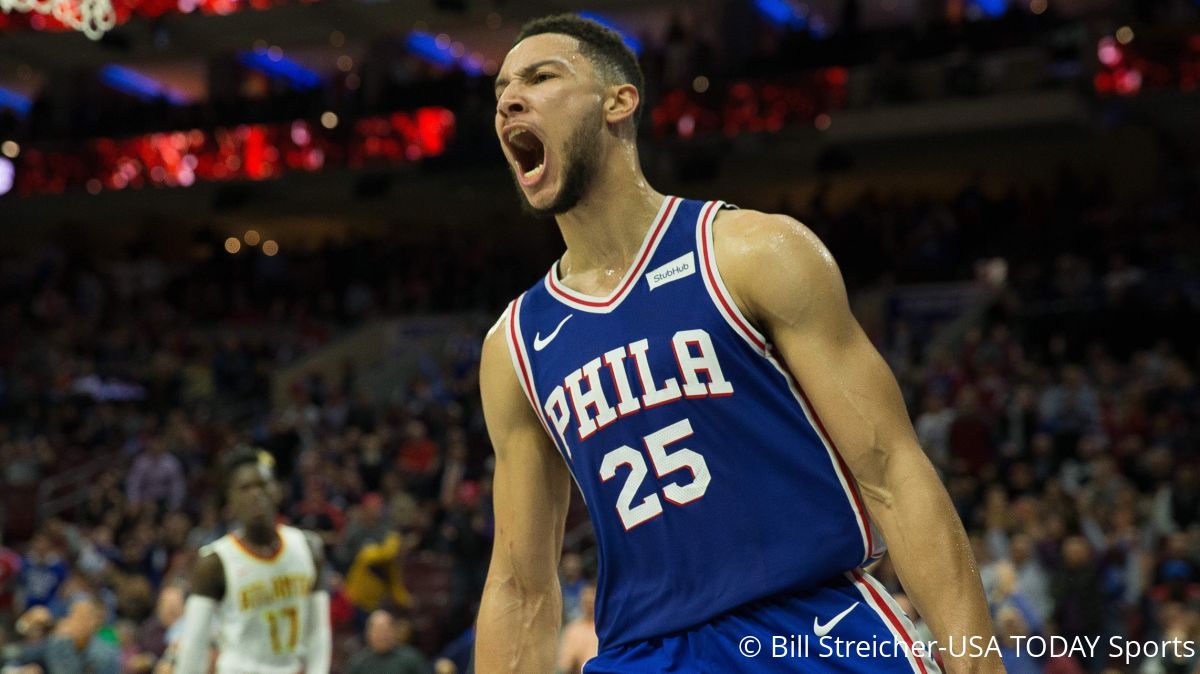
Few men who so clearly were marked as “top pick in the draft” talents before they hit college drew as much opposition to that evaluation as Ben Simmons did in 2016.
His lackluster season at LSU—walking around the court on a team that was just not very good—caused a number of NBA fans and executives, alike, to wonder aloud if he was simply another overhyped international star whose lack of motor and broken perimeter shot meant he was doomed to underperform once he hit the elite talent levels of the NBA.
After Simmons missed last season due to an injury, speculation along these fronts grew, only to die quickly once the actual games began. Utah's Donovan Mitchell has had an outstanding rookie season and may indeed sneak away with some Rookie of the Year honors by some media outlets, but there is but one rookie who seems destined to be the Most Valuable Player of the league and it’s Simmons.
In less than six months, the only question NBA experts and fans are now asking about Ben Simmons are:
“When will he lead Philadelphia to a title?”
“Why did people get Simmons so wrong after first being so right about this talent?”
“Can he be an MVP candidate without a consistent ability to score from the perimeter?”
Ben Simmons to Jarrel Martin: “You know you can’t guard me right? You can’t guard me.” ?? pic.twitter.com/7BTMU1cXal
— Drew Corrigan (@Dcorrigan50) March 24, 2018
To understand why Simmons’ play at LSU was a mirage that had absolutely no meaning, I will use a quick anecdote from my book, “Basketball is Jazz.” I watched Amar’e Stoudemire, then a high school senior, play against my alma mater, Sanford (FL) Seminole, in a tournament near my home in St. Petersburg.
Seminole was short, slow, not very skilled, and not any good. It was one of the lesser teams in the area conference—yet, it had no trouble beating up Stoudemire’s team. He was one of the highest-rated players in America, the darling of the summer camps, and totally unable to accomplish much against a team that had zero players remotely considering playing after high school.
Amar’e had been targeted as a likely “prep to pros” guy and it made no sense to me at all. He jogged around the court, got beat for rebounds, failed to cut angles off on defense, or really do anything at all helpful to his team. It seemed impossible to me that he was an NBA prospect ready to play in a man’s league.
Of course, less than 18 months later, he won the NBA Rookie of the Year award before becoming one of the league’s best players for a number of years.
The lesson I learned was profound: Bored players don’t at all resemble their typical selves, and it’s not possible for anyone to be bored in NBA games. Amar’e was clearly so much better than his opponents in high school, both during that game and for the entire season, that he just couldn’t even feign interest in competing. He had just joined that team and had no connection to the players or the coach.
Ben Simmons knows what that feels like.
An Australia native, he did not grow up dreaming of American college basketball. It was a means to an end. Experts who panned him for his lack of effort and ability to lift LSU out of mediocrity in the SEC failed to factor those simple facts into the equation. Thus, the talk that he had issues that made his pro potential seems less of a sure thing.
Like Amar’e, he, too, should be the league’s Rookie of the Year in his first full season removed from walking around a court filled with inferior players.
The Simmons of today can be described in many ways, but “bored” would never be one of them. He’s been everything the Sixers could have hoped for, and I’d argue he’s been better than they anticipated.
Simmons is a versatile impact player on offense, defense, and rebounding, with a long list of things he does well—or, in some cases, elite. His passing talent has long been lauded, and his assist statistics already suggest he will continually rank among the league leaders (he sits fourth overall in assists per game currently).
But it’s not just his passes to a cutter in traffic or his ability to drive and kick to the nearest shooter that makes him special.
Simmons is uniquely gifted at hit-ahead passes to racing teammates, earning them chances at buckets they often would not get if he were less willing to throw them. Players love running for point guards like Simmons, who help them feel a part of the overall offensive plan despite having few plays called for them. And Simmons can throw these passes across the court, typically not an option or even something a coach would want. He’s a genius, like LeBron, in that way.
Everyone seems to be just one bullet pass away from getting the ball before making a play.
Philly played fast the past few years to better help its draft slot—less talent plus more possessions equal more losses—but also because the Sixers knew it’s how they ultimately wanted to play. Great foresight, sure, but there is no way they saw a talent like Simmons coming when they first began “the process.”
They play at the fifth-fastest pace in the NBA, a fitting speed that should be maintained more or less in the playoffs precisely because of what Simmons does with those passes.
Simmons isn’t just a setup man. He combines great speed and change-of-pace attack moves off the dribble to get to the rim. Most of his made field goals are in the paint, where his size and ambidexterity can be best used to his advantage.
Because of this, his passing talents are even more valuable, as help defenders who arrive to prevent an easy shot by Simmons become even easier buckets for teammates.
Ever on the attack, Simmons either uses early ball screens or his own body to get an advantage over his own defender, thus a 5-on-4 situation occurs. It’s what most great players can create, but few have his passing ability. It's one reason why he ranks in the 96th percentile among NBA point guards in fouls drawn. He is both patient for the play to develop and ready in an instant to deliver a perfectly timed assist.
Just a rookie, Simmons already is one of the most prolific transition players in the world as a pure points producer.
In the half court is where his lack of shooting is obviously a problem. Simmons constantly is given a “bubble” of space by his defender, inviting a jump shot that he is reticent to take. He will take them, and the shot looks fine, not great, but good enough to be a weapon.
The problem is that it’s less a threat than a 3-point shot, so teams would prefer that over his drives to the hoop where he gets a great shot for himself or a teammate. If he were to add a 3-point shot to his game, he’d quickly become one of the few best offensive players in the league, alongside tall forwards like LeBron and Kevin Durant and playmakers and scoring supremes like Steph Curry and James Harden.
He is an amalgam of them all or would be if he could get to even 35 percent behind the 3-point line. For now, instead of a perimeter and driving threat, he is a decent post player, with a very good weak hand that allows him to finish over either shoulder.
He makes plays from that position, as well, happily finding cutters or shooters when defenses slip down to offer their smaller teammates help.
Simmons isn’t adept as a post presence yet like he one day will be, but looking forward, it is easy to imagine coach Brett Brown building some playoff play designs around his post play, as it allows him a totally different way of breaking down defenses with his star rookie that does not force him to beat defenders through lots of space.
It’s an energy saver—and an effective one.
Simmons is capable of guarding all five positions on defense and is top 10 overall in steals, top 50 in blocks, and third in triple-doubles. So finding ways to rest him on offense has real value.
As he has already proven, Ben Simmons without a perimeter shot is a longtime all-star who can be the best player on his team in any postseason series. He affects the game in so many ways, with the potential to get much better at each aspect of his current play.
Offensively, though, adding an extra point to his shooting range completely changes the narrative, because it will create an even wider range of open space, within which he can take advantage as a passer or driver.
A Simmons who makes 3s will lead the NBA’s top offense. At that point, he will not only have the potential to be the best player in a series, but he will also be on the short list for best in the entire league.