LeBron, KAT Headline List Of ‘Shining’ Plays You Might’ve Missed
LeBron, KAT Headline List Of ‘Shining’ Plays You Might’ve Missed
Blink and you missed it. Not all of these plays from this week in the NBA will make the highlight reel, but each represents a vital element of the game.
Unlock this article, live events, and more with a subscription!
Already a subscriber? Log In
Basketball is a game featuring countless variables on every possession.
Almost every second, both offensive players and defenders make obvious choices that matter but rarely get mentioned.
Here are five such examples from this past week—some of the plays you saw on highlight reels, some appeared unremarkable, but all feature important elements of the game that are easy to miss.
How To Use A 3-Point Shooting Center
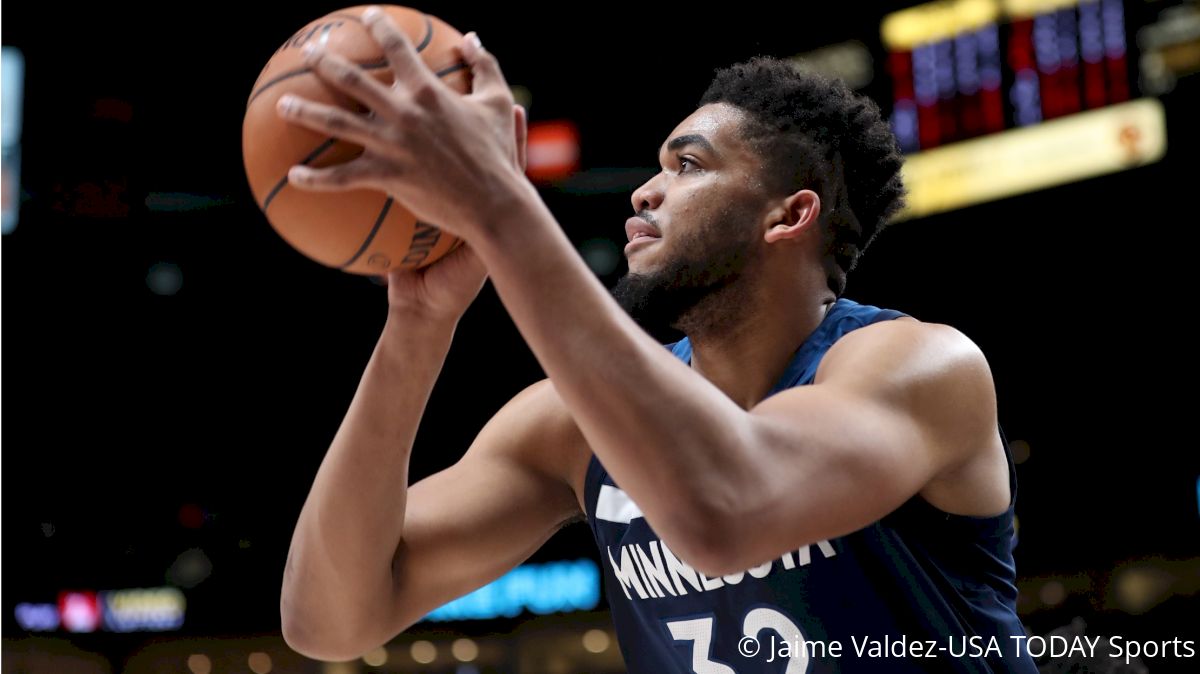
Karl Anthony-Towns scored a career-high 56 points in Minnesota's 126-114 win over Atlanta on Wednesday night. At 22 years of age, he is likely the single most offensively skilled true center in the league.
There are many of us who have expected this kind of explosion from him for some time. He is a 40-plus percent 3-point shooter. He can play bully ball down low and score on hook shots over a center. He can beat smaller men off the dribble and finish strong, too, meaning he can post anyone and drive on at least half of the men who are asked to defend him.
In short, he should be unstoppable on offense, which he has not been very often to date.
Kevin Durant made the transition from volume scorer to elite-level scorer with great efficiency once he added ball-handling skills to his game and the OKC offense worked to feature him in specific positions on the court to take advantage of what he did great.
This baseline out-of-bounds (BLOB) play is a sign the Timberwolves are doing the same thing for Towns.
Take a look at how Atlanta is defending this “line” set. Obviously, the Hawks expect Towns to dive or screen down for perhaps Jeff Teague or another teammate. That is a common action in a “line” inbounds play.
But Towns is such a great shooter, so it works well to have Teague screen, in a sense, both his man and Towns, allowing Towns to gain even more space than he first had before the ball was handed to the inbounder to pop out for the shot. In no small way does this design show how different the game is now—this was no set piece to win a big game.
It was just a weeknight game against a bad team, but it’s wise for Minnesota to feature Towns in as many ways as it can. It’s been a long time before Towns got his first 50-point game. I’d be surprised if he didn’t get a second one far sooner.
Using LeBron As A Screener
LeBron James has long since sealed his place among the very elite few scorers in NBA history. Retiring tomorrow would not change that.
He’s also listed alongside Magic Johnson as the top two passers/playmakers in history for men their size (Larry Bird is in third). When the ball is in his hands, there is almost no set that can’t work, and no NBA players who couldn’t play on the court spaced away from him with a live dribble.
However, with Cleveland dealing yet again with no secondary scorer who amounts as special (Kevin Love is out again), running an offense in which LeBron is always asked to be both scorer and playmaker every possession can extract a toll, too—in theory anyway.
The Cavs would be wise to consider actions that have him make plays away from the ball, forcing defenders to focus on him with fewer resources locked in on the ball, or the opposite, where then LeBron is suddenly a little freer. And in a perfect play, LeBron does something away from the ball and then charges towards the rim.
LeBron moving with pace is still one of the best forces of nature in the league. Cleveland showed us just that in the Cavs' 118-105 win over Charlotte on Wednesday, perfectly.
LeBron first races toward the ball handler looking to set a ball screen. Without a doubt, this set some Hornets brains in motion on how to defend the play. But before he arrives at the ball, he quickly veers to the wing and pins JR Smith’s man, allowing Smith to curl around him in a direct line to the rim.
Smith isn’t Kyrie Irving but he is capable of making a layup or making a pass to an open shooter.
This action froze LeBron’s defender, who’d hung back off of LeBron as he screened for Smith. He didn’t commit to challenging Smith, and he didn’t hang back to prevent the lob. In essence, he offered almost nothing, as the speed of the action clearly surprised him—which is why Smith was able to throw an underhanded lob to LeBron as he ran downhill for the dunk.
Postseason Cavs actions should feature more of this kind of stuff.
Running Actions vs. Isolations
It’s more than common to see an NBA team clear space for its best scorer and hope he gets a basket or a foul or finds an open teammate when it needs to score to tie or win a game on the last possession.
But in a tie game in Utah on the game's last possession, Boston didn’t have Kyrie Irving to make its play. So instead the Celtics ran an interesting action against Utah’s elite defense, anchored by defensive monster Rudy Gobert.
Boston used five perimeter players, meaning Gobert had to guard a wing, choosing Semi Ojeleye, the least likely man to take a deep shot. The Celtics had Jalen Brown halfway up the key and shooters in the corners, with Semi perched high left. Gobert clearly had no intentions of guarding him and instead wanted to protect the rim, making perfect sense in a tie game. So when Shane Larkin attacked the congestion caused by the “semi” cut run by Semi, Gobert stayed home.
That meant that three Jazz players were in the paint, leaving two to defend four as three Boston players were behind the 3-point line once Larkin flipped the ball out to Semi.
Utah panicked and initially had two defenders racing out to him. That false step by Gobert cost the Jazz because Brown was that fourth player on the perimeter and he was able to quickly slide behind the line and take his shot in rhythm.
Without a star offensive shot creator, Boston got an open shot by running a different “look” to win a game.
Playing A Vertical Game
Some point guards are reluctant to throw the ball ahead to streaking teammates unless they are sure they’re wide open for the easy bucket. Russell Westbrook best represents this player. He wants to be in control of it all.
Many guards are willing to throw it to force tempo, though they typically only consider it when the player is directly ahead of them. It’s an easy pass with low risk and it can end up in an easy basket for the racer or a teammate. Very few players are both willing and able to throw that ball ahead diagonally toward the other side of the court.
Passing through the middle of the defense (most defenders get back down the middle third of the court) is fraught with risk and it takes bullet passes with great accuracy. Remember, it’s like a quarterback throwing the ball down the field but not in a straight line. Timing is crucial.
Ben Simmons is a master at this, maybe already the league’s best, and his teammates are happy to sprint the court, trusting that he is looking.
On this play, notice Michael Beasley, who moves toward the pass for a moment then relaxes as he assumes Dario Saric has a layup—a typical result from one of these Simmons passes. The error gives up the open corner 3.
The Sixers generate points by just racing and trusting in Ben.
Shot Fakes As Weapons
Why do players use shot fakes in games? Yes, to get a defender off his feet and perhaps draw the foul—or to get the defender to “stand up” and perhaps then be able to maneuver around him for a better-angled finish.
But there’s another vital attribute to using fakes: It can throw off a defenders timing to block the shot. A shot-blocker needs to time his leap in sync with the shooter to maximize his chances of being successful.
Zaza Pachulia is not long or athletic, though he is tall. It looks, here, like Myles Turner has him dead, with no options except to just throw the ball out to a teammate or up toward the rim and hope it falls.
Turner is just too long for Zaza, which is why the veteran uses a fake—not one, either, but three timed irregularly. Turner jumps too early, allowing Pachulia to rise up and score the easy basket as Turner is dropping down to the ground.