Dame's Coming: Lillard Is Carrying Portland Into Title Contention
Dame's Coming: Lillard Is Carrying Portland Into Title Contention
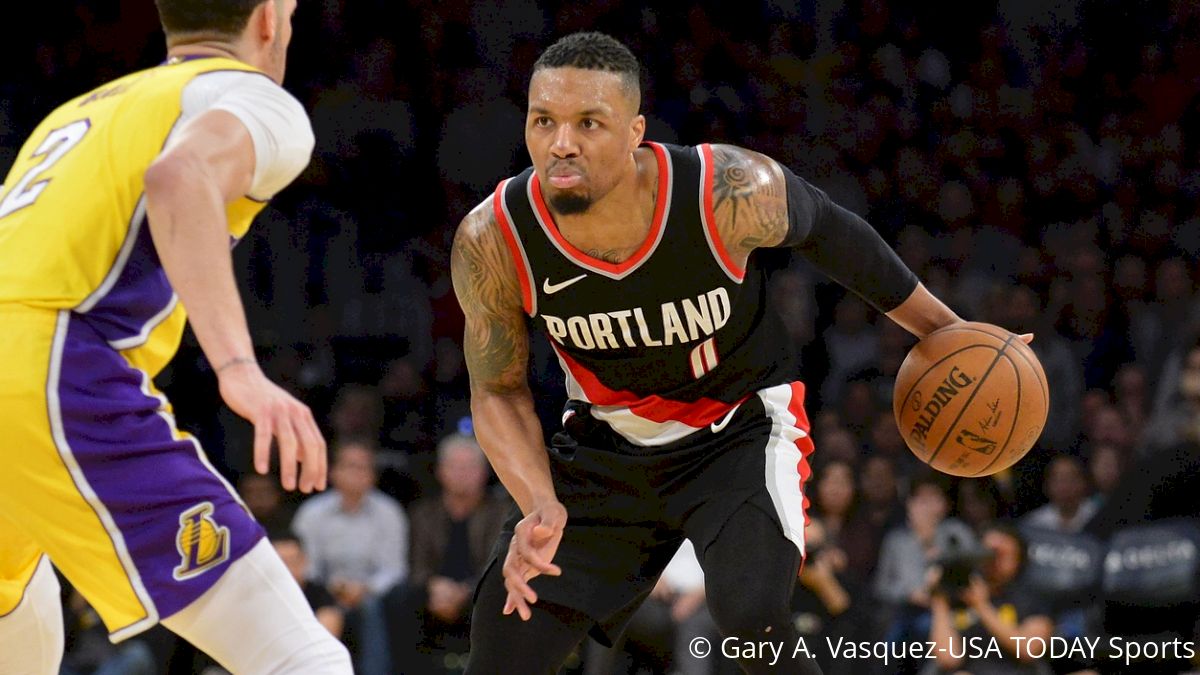
With Damian Lillard playing at an MVP level, the Trail Blazers are an unlikely title contender out of the Western Conference.
Unlock this article, live events, and more with a subscription!
Already a subscriber? Log In
If I asked you to name the top three players under 6-foot-4 in the NBA, you’d immediately say “Stephen Curry, Kyrie Irving, and...”
And then you’d probably have to think.
Maybe you’d come up with the obvious third choice. Maybe not. But, after reading this, I hope you won’t have to think about it any longer. Because Damian Lillard is one of the top players in the league, deserving of votes for MVP, and he is proving he can carry a franchise to lofty heights in a way that's more impressive than anything Curry or Irving has had to do.
To best understand Lillard's dominance—before we look at statistics or wins—it helps to consider a "simple" explanation of how teams are scoring in the half court today: 3s and ball screens.
The Portland Trail Blazers point guard represents the best example of a shorter player excelling in that environment.
He isn’t the pure shooter Curry is—or Irving, for that matter. And he isn’t the elite athlete on the level of fellow 6-4 guards John Wall or Russell Westbrook. What Lillard is, though, is a more dynamic player with the ball than all of them, when factoring in athleticism, skill, and craft—with an excellent perimeter shot for such a high scoring player.
Study Lillard on the attack and you will see a ball handler who is expert at the “hesitation and go” (hesi-go), a stupefying move because of his ability to rise and shoot so well. The bigger, taller, bouncier Westbrook can always get that shot off not just because he is physically gifted but also because that’s what defenses want him to do.
Not so with Lillard, typically.
He uses that hesitation like a sledgehammer, routinely stopping and starting as he dribbles on the perimeter or on the attack. A screen or two makes it almost impossible to stay connected to him as he skips or speeds to the rim. Though he’s not a finisher quite at the level of the most elite slashers, he is good enough—thanks to his incredible craft and creativity at the rim—to be a foul magnet.
Lillard ranks third, to date, in free throws made this year, behind only James Harden and Giannis Antetokounmpo. Not only is he getting himself to the line often but he does so for his teammates, as well, with Lillard being one of the leading non-shooting foul-drawers among point guards.
The Blazers rank third in overall free-throw percentage, so getting to the bonus each quarter is a “bonus” indeed. Lillard, himself, ranks fourth overall in free-throw percentage, so his ability to draw fouls off those dribble moves of skill and craft is a big part of his high points per game average.
Lillard at the rim is far more craft than explosion, changing speeds to keep defenders guessing, scooping shots under the arms of taller defenders, and using one hand the entire way instead of gathering—which creates a surprisingly sudden finish. What Lillard lacks in purely physical gifts, he more than makes up for in skill, but don’t mistake that characterization as an indictment of his athleticism.
By no means is Lillard a bad athlete. He’s a great athlete with elite shot-making artistry.
His passing skills are excellent, too. He's maybe not as “gifted” as a Ben Simmons, with incredible vision and pace to his passes, but Lillard is a smart veteran who reads the game and makes the right play far more often than not.
Of the 10 NBA players with a usage rate over 30 percent, only Lillard and Irving have a turnover rate of 9.0 or below. It’s another big part of what Lillard means to his team, as the Trail Blazers rank fifth overall in lowest turnover rate. His job is to score, first and foremost, and doing so without much of a turnover risk, and against opponents whose main defensive goal is to slow him down, best signals why their offense has been solid this year.
When Irving is not on the floor, the Boston Celtics outscore opponents by 1.9 points per 100, and they win by 6.7 when he is on the court. It’s a different story for Portland, which loses by 5.4 points per 100 without Lillard and wins by that exact amount, 5.4, with him.
Lillard is poised and steady, rarely rushing. He’s the fuel that makes the Trail Blazers go—and their best scorer when they need that, too.
Of course, no study of Lillard is complete without looking at his 3-point shooting and its effect on Portland's offensive game plan.
Lillard is a very good 3-point shooter, though not a great one. He has never made better than 39.4 percent of his 3s and has not been above 37.5 percent in any of the past four seasons. But it’s his willingness to take them, a lot of them, many from far deeper than most good shooters will attempt shots from, that creates much of the space the Blazers use to pick teams apart.
Lillard ranks third behind two Houston Rockets—Harden and Eric Gordon—in 3s attempted this year and is seventh in total makes. He is easily good enough to demand attention wherever he is, because he just might shoot at any point.
Stay close and he can zoom a pass to a cutting player or drive through an open gap. Lay off and he makes enough to hurt the defense for doing so.
Some might call this the “Curry Effect,” paying homage to the deep shots Curry takes and makes. But they are contemporaries, and Lillard has played this way for quite some time. His bravado, confidence, and poise with the ball have helped Portland establish a solid offense that is above average and getting better.
The Trail Blazers are 19-4 since a three-game slide during the first games of February, playing incredible defense in that stretch. They still need to generate enough points to win, and thanks to playing at a very slow pace with few transition baskets (26th in fastbreak points), they must rely on their half-court execution more than most good teams. Lillard is their bread and their butter.
A quick word on Lillard’s defense: As mentioned, Portland has risen to be one of the top league defenses thanks to outstanding 3-point defense. The Trail Blazers are third overall in preventing 3-point attempts, an impressive rank made more impressive when considering they start two smaller guards. Josef Nurkic’s presence inside as a rim protector makes that system work, as Portland counts on him and Ed Davis (his backup) to make rim finishes tougher—and teams get lots of rim attacks precisely because of their extreme closeouts on those 3s.
Lillard is not a good defender but he is executing within the Trail Blazers' system at a high level. With how much they count on him for offensive help, he is doing a fine job on the other end.
Portland’s rise into title contention comes in year five of its consecutive playoff streak (clinched again on Sunday). Looking ahead, it’s clear that this group is built to last.
If either Houston or Golden State stumbles just a little bit this year or in future seasons, Portland appears poised to pass that team on the ladder. Damian Lillard is now getting the respect he deserves as a player, and after those MVP votes come his way this spring, he will be widely considered to be a legitimate MVP candidate, both next season and beyond.
He is truly one of the games most elite players.