KIROLBET Baskonia Vitoria-Gasteiz has been a club with great ambition dating back to the inaugural EuroLeague season, when the team then known as Tau Ceramica reached the best-of-five finals.
They say reaching the top is difficult, but staying up there even more so. By reaching the 2001 finals, Baskonia took the first step to becoming a EuroLeague powerhouse, but by making it to four consecutive Final Fours from 2005 to 2008, the club cemented its status as one of the central teams in the competition – and, thusly, as one of the best squads in continental basketball.
Only one player took part in the 2001 Finals and in the club's four consecutive Final Four appearances: swingman Sergi Vidal, who currently plays for fellow Spanish side Cafes Candelas Breogan. Vidal joined Baskonia in 2000 and left at the end of the 2008-09 season, which makes him the right player to talk about the club's golden age.
"The club was clearly on its way up going into that final after a few good years. It had played some finals, won a Copa del Rey [in 1995] and lifted a European trophy [the 1995-96 Saporta Cup]. It was on its way up, but nobody expected us to make it to the EuroLeague Finals in the first-ever edition of this competition," Vidal said. "We played without the home-court advantage and eliminated three Greek teams, which was a very difficult thing to do back in the day. We beat Olympiacos and AEK to reach the Finals against the mighty Kinder Bologna, the best team in Europe back then. Even with that, we managed to force Game 5 and play do-or-die for the title at their home court."
Slowly but steadily, Baskonia took giant steps in terms of competitiveness, led by head coach Dusko Ivanovic and players like Luis Scola, Andres Nocioni, Jose Manuel Calderon, Arvydas Macijauskas and of course, Vidal. Baskonia won its only Spanish League and Cup double in 2002 and lifted the Copa del Rey again in 2004. Nocioni left before the start of the 2004-05 season, but with Macijauskas and Scola as its main leaders, Baskonia was ready to be successful in the EuroLeague again.
Despite a slow start – winning just four of its opening 11 games, Baskonia qualified to the Top 16 and swept Benetton Treviso in the quarterfinals behind a huge Game 1 from Scola; Baskonia won 59-98 in Treviso and Scola had 34 points on 15-of-16 two-point shooting for a PIR of 43, which remains the highest mark in a playoff game since that phase was reintroduced in 2005. Baskonia reached the 2005 Final Four with a 12-10 record and had to play against CSKA (21-1) in the first semifinal in Moscow. Despite being a heavy underdog, Baskonia played a near-perfect game and eliminated CSKA 78-85 behind 23 points from Macijauskas and 13 from Calderon. It is one of the biggest upsets in EuroLeague history.
"That Baskonia team never listened to those who said you couldn't win a game or beat a certain opponent. We always believed we could beat anyone, even when we were aware it was difficult to beat CSKA in Moscow," Vidal remembered. "We had a lot of talent and character, with a great winning mentality. That would be the definition. People didn't go to Vitoria to earn a better contract the following season. They came knowing you would work hard, but have a chance to win. It was one of the games most people remember.
"Macijauskas hit a corner three-point shot to beat the shot clock buzzer in the final minute. If you see it on TV, the ball disappeared from the camera shot. He shot with such a high arch that it disappeared from the TV screen! We had our chances and those increased as the game went on," Vidal said. "We had some previous experience playing against top teams, in which arriving at the end of the game with a tied game was not enough. You couldn't just see what happened at the end of the game - in order to beat those teams, you need to have a good lead. We didn't stop fighting until the final seconds, and that is when we realized we had won."
Once in the championship game, Baskonia was unable to beat reigning champion Maccabi, which successfully defended its title, 90-78. Sarunas Jasikevicius had 22 points, 6 rebounds, and 5 assists to earn 2005 Final Four MVP honors. Scola led Baskonia with 21 points.
"I don't think we ran out of gas. Maccabi had a very good game plan. We lacked some experience in games like that and they handled it very well," Vidal recalled. "We competed hard, but there were moments in which they hit the right shots at the right time. Some players that were not expected to be the main characters in that game played really well, and then, of course, Jasikevicius's leadership. Every time he was on the court, he had full control of the game."
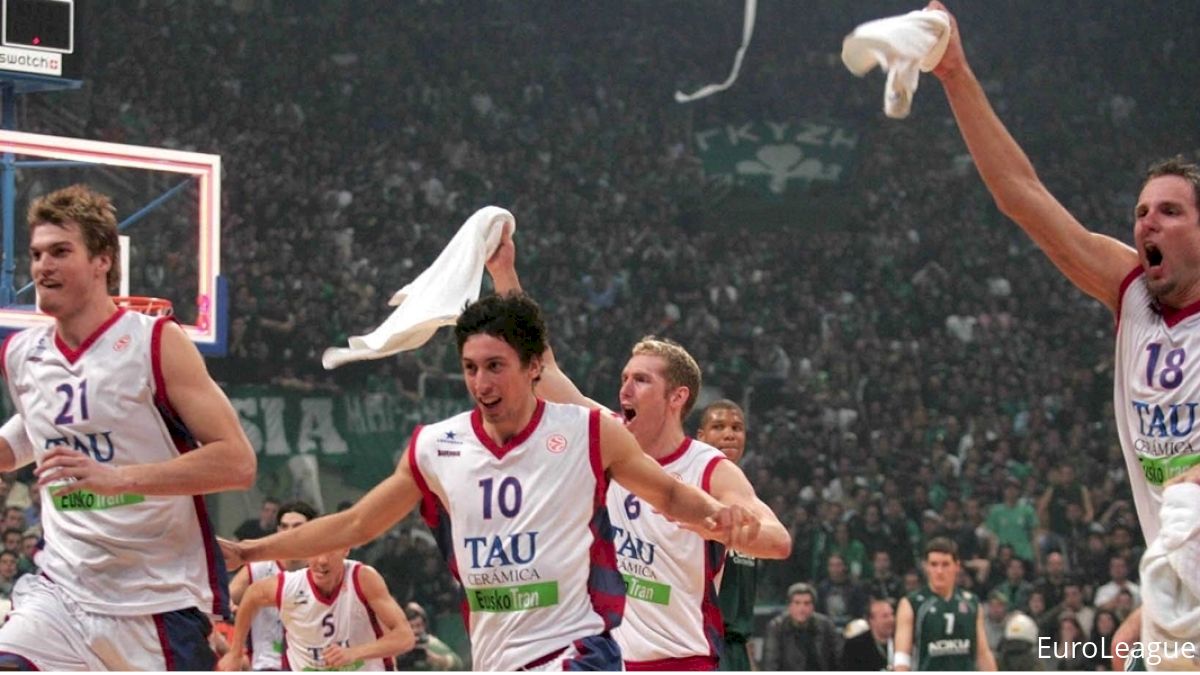
A year later, Baskonia continued writing its history with golden letters. The club, now coached by Velimir Perasovic, went past the Top 16, but did not have the home-court advantage in its playoffs series against Panathinaikos Athens. Down 1-0 after an 84-72 road loss in Game 1, Baskonia tied the series with an 85-79 home victory thanks to 21 points from Travis Hansen and 20 from Scola. Back to Athens for do-or-die Game 3, Baskonia managed to pull off the upset, becoming the first – and to date only – team to win a deciding playoff game on the road. Serkan Erdogan had 24 points to bring Baskonia to the final seconds with a 71-74 lead. Fragiskos Alvertis had a chance to tie the game, but his three-point shot hit the back of the rim. Immediately after the miss, the while Baskonia team ran to the locker rooms, waving towels in front of a shocked crowd.
"It was a very funny moment. There is a picture of that moment which I love; we were all running and laughing, very happy but at the same time, freaking out! I love that picture, it is so funny; all of us running to the locker room with towels on our heads," Vidal remembered. "We had a mix of emotions, thinking about what we had just achieved, but also running to the locker room as fast as we could!"
The opponent in the semifinal was a familiar one. It was the same Maccabi team that had eliminated Baskonia in the previous season's championship game and once again, the Israeli champs had their number. Maccabi rolled to an 85-70 victory and its third consecutive championship game.
"We didn't have any chance against Maccabi in the semifinals," Vidal said. "Sometimes it is complicated like that, mainly because you never know when you will be back to the Final Four. You try to give your best, but a Final Four game is no ordinary one. We are talking about the best teams in Europe and if you don't play at your best level that day, you obviously have no chance to win, nothing you can do."
A year later, Baskonia was still led by Scola in what would be his final season in the competition. Scola left in 2007 as the competition's all-time top scorer and the first player to reach 2,000 career points. Legendary coach Bozidar Maljkovic joined the team a few weeks before the Final Four and Baskonia had new important players such as Igor Rakocevic, Pablo Prigioni and Tiago Splitter. Baskonia was undefeated in the Top 16 and swept Olympiacos in the playoffs to reach the Final Four in great shape; it had won 20 of its previous 21 EuroLeague games. The Final Four was played in Athens and Panathinaikos was its semifinals opponent one year after what in the Greek capital had been dubbed "Oakazo", which translates roughly as "upset at OAKA." Panathinaikos prevailed this time, using great defense to beat Baskonia 67-53 behind 15 points each from Sani Becirovic and Mike Batiste.
"A lot of times, these kinds of games are not fun-to-watch or high-scoring showdowns. Generally, you are more worried about playing good defense. It wasn't the most beautiful game in the world, but we fought hard and had our chances. Panathinaikos had in mind what happened the previous year and with the game being played at OAKA, it was hard to beat them again," Vidal said.
Baskonia would reach a fourth consecutive Final Four in 2008. The arrivals of Zoran Planinic and Pete Mickeal allowed the club to remain fully competitive at the highest level despite the roster turnover. A 5-1 Top 16 record led to home-court advantage for the playoffs, which was critical against Partizan Igokea Belgrade. Baskonia downed Partizan 85-68 in Game 3 behind 19 points from Mickeal and 18 from Planinic. Baskonia had all it takes – experience, depth, competitiveness – to mount an assault in Madrid and come back home with the trophy, but first had to get past one of the best teams in competition history.
CSKA had a little bit of everything in the 2007-08 season. Ramunas Siskauskas had joined a group of elite players who had been together for many years, including Theo Papaloukas, J.R. Holden, Trajan Langdon, and Matjaz Smodis, among many others. Baskonia led 61-59 with 7 minutes left, but Papaloukas led a 0-10 run which gave CSKA full control of the game. CSKA prevailed 79-83 and went on to win the title.
Looking back, Vidal is proud of reaching so many Final Fours – and he would go to another one with Real Madrid in 2011, but at the same time, being so close so many times left a bitter taste. "It is a bad feeling – being close to the EuroLeague title so many times and not being able to lift the trophy. Playing one Final Four is already complicated and winning it is even more difficult. We had to play against Maccabi, CSKA, Panathinaikos... and you eliminated some good teams just to get there," Vidal said, pointing out that Baskonia did everything it could to lift the trophy.
"I always wanted more, but reaching the Final Four for four consecutive seasons was a luxury and a success for the club and the city of Vitoria. Even so, you always regret being so close to the title. Sometimes a few minutes made the difference. It was Papaloukas this time, but it could have been anyone: Langdon, Holden, Andersen. It doesn't matter. When you have such a great roster like CSKA had that season, anyone can step up and be key."
Baskonia has only been back to the Final Four once since its amazing run in the 2000s. It was in 2016, with Ioannis Bourousis, Adam Hanga, Mike James and Darius Adams as its pillars. Baskonia lost in overtime against Fenerbahce Istanbul in the semifinals. Adams had a chance to win it at the end of regulation, but his shot did not go in and Fenerbahce prevailed in overtime 88-77.
Now the Final Four comes to Vitoria-Gasteiz, even though Baskonia won't be there to compete. Vidal knows that Baskonia fans and the City of Vitoria-Gasteiz will live up to the expectations. Thanks to players like Vidal, everyone in the city is aware of how much of a great event the EuroLeague Final Four is.
"All players who wore Baskonia's jersey – and I did for many years – are proud of the team. My heart will always have a baskonista part, I will never deny it," Vidal said. "It couldn't be any other way. I played there for nine years and we had an unbelievable run. The fans were great to me, too. I am always happy for their success. When I heard that Vitoria would host the Final Four, I felt really happy, because it has been looking to achieve this goal for many years. The atmosphere at Fernando Buesa Arena will be worth whatever people pay for the tickets!"